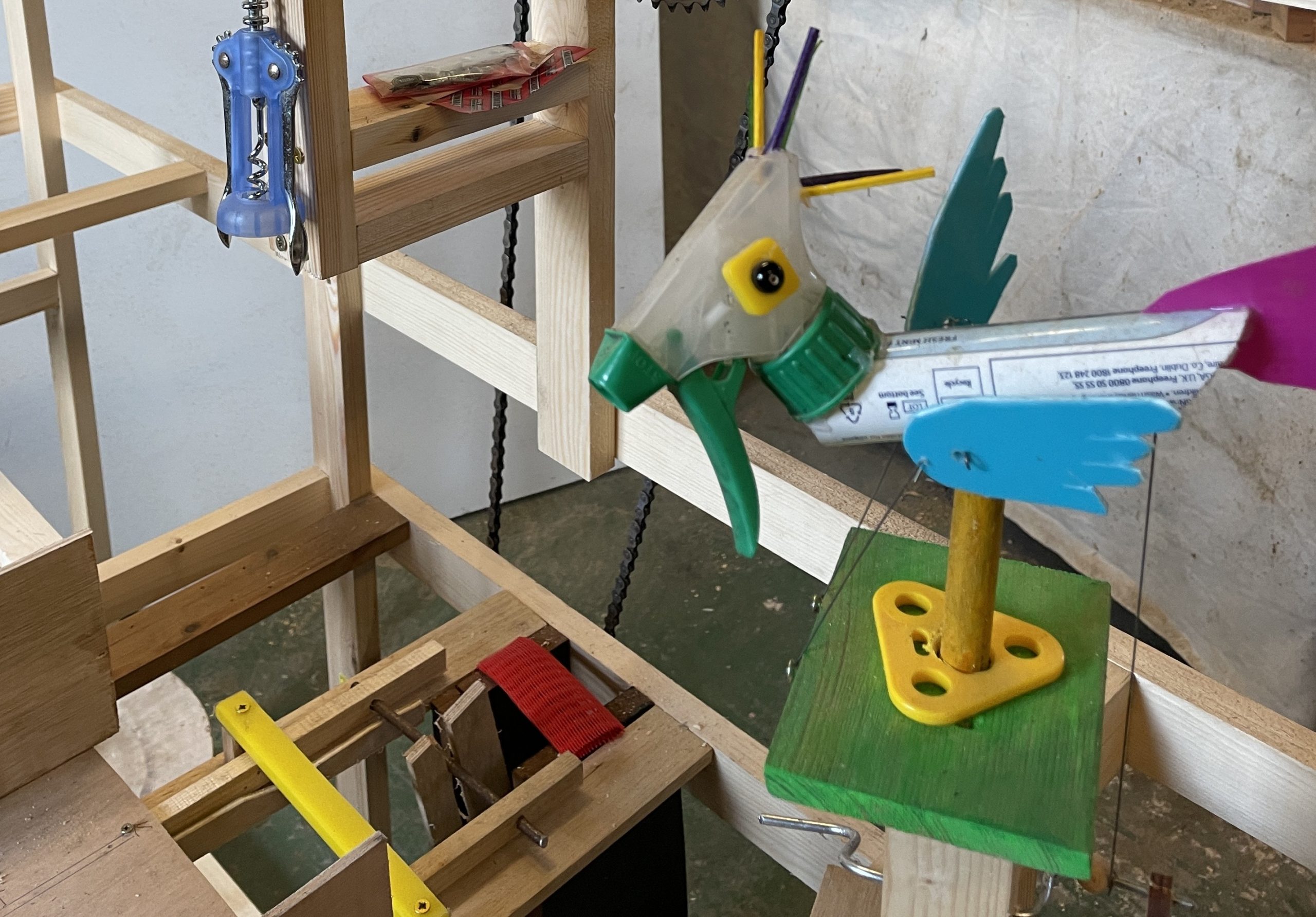
A kitchen dresser, with shelves are filled with familiar objects: brushes, bottles, cloths, containers. Everyday things. But when you look a little closer, you see a handle attached to the side. Turn that handle, and the dresser comes alive.
Lights flicker across the surface, casting shadows and revealing hidden connections. And all of the workings are exposed: the wires, the cogs, the pulleys, the joints. Nothing is hidden.
Slowly, the objects start to transform. A brush begins to rotate. A bottle rises and falls. A container tilts and tips. From these everyday tools of domestic life, new forms emerge. The dresser becomes an automaton, and its objects reshape into an animal, or even a human figure. The familiar is unsettled, and reborn into something playful, surprising, and alive.
The materials used also carry meaning. Many will be broken, discarded, or plastic things that have been thrown away. By collecting and reworking these into the dresser, they are given a second life. Nothing is wasted.
Links
About the Artist
Carlos Zapata makes idiosyncratic carved and painted sculpture and installation. His work deals with many challenging and potent themes from poverty, conflict, religion and race, yet paradoxically, the overriding characteristics of the work are of empathy and compassion. Alongside this, Carlos has a long history of making automata, first in theatre settings, now often one-off commissions for private collectors, responding to personal experiences and requests, or for public institutions, drawing inspiration from the history or collection of the institution. In the last 28 years he been commission by museums, public spaces and private collectors in Europe, Asia and America.